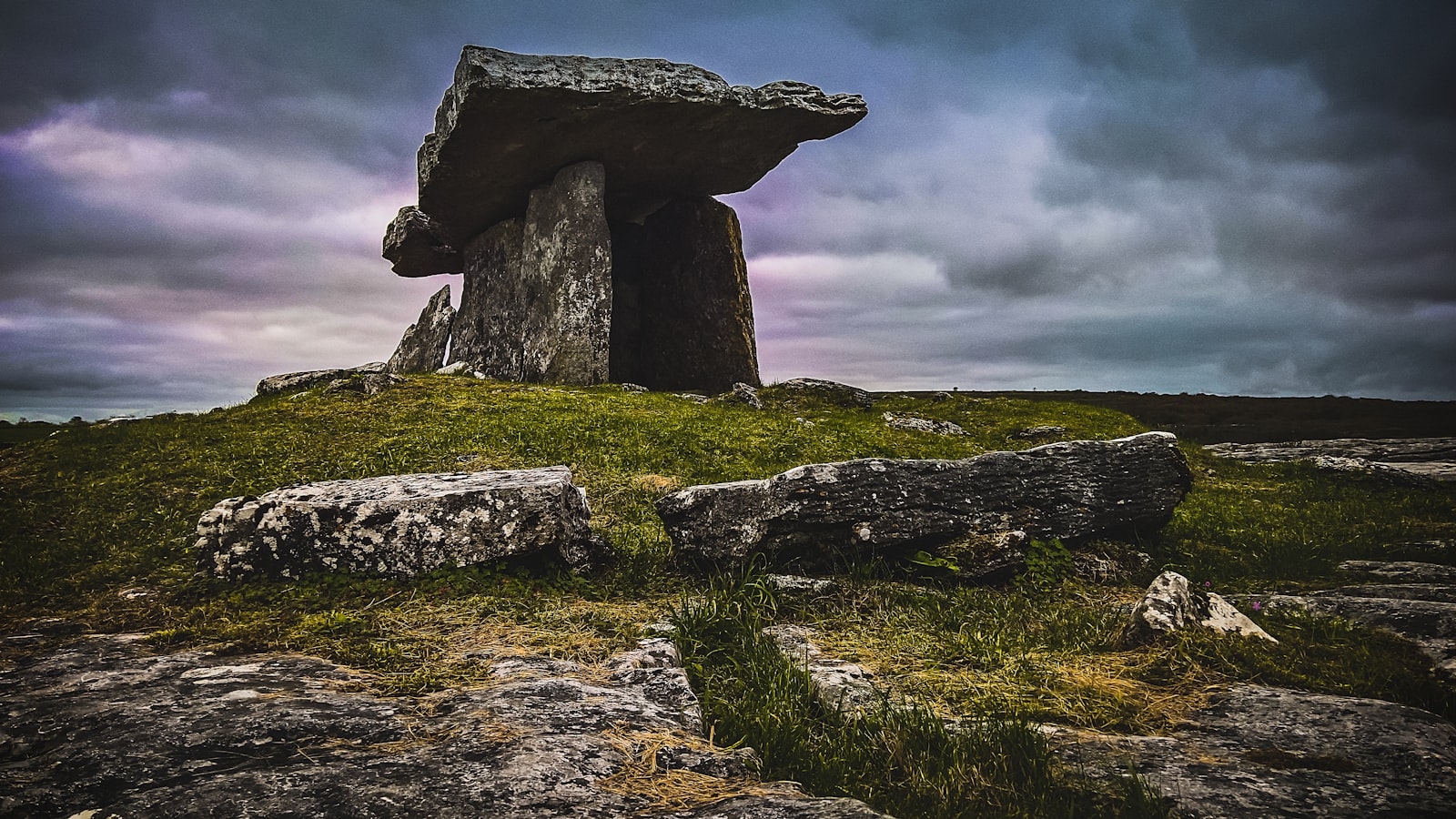
Photo by K. Mitch Hodge on Unsplash
When most Americans think of Irish druids, images often come to mind of wizards in flowing robes, communing with nature and performing mysterious magical rituals at Stonehenge. The reality of ancient Celtic religion and the druids who led it is far more fascinating, complex, and grounded in historical evidence than popular culture suggests. Yet it’s also far more elusive, since the ancient Celts left us no written records of their own beliefs, and our knowledge comes filtered through the accounts of Greek and Roman writers who often viewed these cultures with a mixture of fascination and disdain. Understanding what we actually know—and what we don’t—about Celtic religion requires us to separate historical evidence from romantic legend.
The Challenges of Studying Ancient Celtic Religion
The fundamental problem in studying Celtic religion is one of sources. The Celts were a non-literate society, at least in their religious practices. They didn’t record their beliefs in sacred texts the way Greeks, Romans, or later Christian societies did. Instead, Celtic religious knowledge was maintained through oral tradition, transmitted by druids and other specialists who deliberately kept sacred knowledge from being written down. This created a paradox: the people who knew most about Celtic religion were specifically trained not to record it.
What we know about Celtic religion comes primarily from several sources, each with significant limitations. Classical Greek and Roman writers like Strabo, Caesar, and Pliny the Elder wrote accounts of Celtic peoples, but these accounts were written by outsiders with limited understanding and, in many cases, a political agenda to portray Celtic peoples as barbaric and in need of civilization. Medieval Irish Christian monks, writing centuries after Christianity had replaced the old religion, preserved fragments of pre-Christian Irish mythology in texts like the Lebor Gabála Érenn (The Book of Invasions) and the various cycles of mythological tales. However, these accounts were filtered through a Christian lens and were often deliberately altered to serve Christian purposes.
Additionally, archaeological evidence provides material artifacts—religious objects, ritual sites, and burial practices—but these require careful interpretation. We can see what Celtic peoples used and where they gathered, but understanding the spiritual meaning behind these practices requires educated inference.
Who Were the Druids?
The druids occupy a central place in our imagining of Celtic religion, yet they were far more than the stereotypical figure of the wise wizard. The term “druid” itself likely derives from Celtic words meaning “the very wise” or possibly “oak-knower.” Classical sources suggest that druids formed a professional class—an elite group of specialists who held significant power in Celtic society as religious leaders, judges, healers, and counselors to kings.
According to Caesar’s account in his Gallic Wars, druids in Gaul underwent an extraordinarily long training period, some accounts suggesting up to twenty years of study. This training was conducted in secret, passed from master to student, and young men of noble birth would seek out the most prestigious druids to study with. The subject matter of this training apparently included religious ritual, natural philosophy, legal knowledge, genealogy, and practical skills like medicine and astronomy. The fact that druids underwent such extended and rigorous training suggests that Celtic religion was not a simple set of folk beliefs but a sophisticated intellectual system worthy of sustained scholarly attention.
The druids appear to have been exempt from military service in Celtic societies, indicating they occupied a special status. They were highly paid for their services as judges and counselors, and they wielded considerable political influence. In some accounts, druids could even intervene in battles, with their authority respected enough that warring armies would cease fighting to hear their judgment.
However, not all Celtic religious specialists were druids. Irish sources mention other categories of religious figures: the file (plural filid), or poet-seers, who apparently had some overlapping functions with druids; the draoithe, another category of religious specialists; and various other ritual practitioners. The relationship between these different categories isn’t entirely clear, and it may be that different Celtic regions had different systems of religious specialization.
Core Elements of Celtic Belief
While we lack detailed doctrinal statements about what the Celts believed, we can reconstruct some major themes from the sources available to us. The Celtic gods themselves are somewhat mysterious, partly because the Celtic regions did not have a single unified pantheon like Greece and Rome did. Instead, there appear to have been regional and local deities, with some gods worshipped more widely than others. The Romans, when they encountered Celtic peoples, frequently equated Celtic gods with Roman deities, which tells us something about the functions these gods served, but this equation was often superficial.
Among the more widely attested deities were Toutatis, called by classical sources “the god of the people,” suggesting a role as a protector and founder of tribal groups; Taranis, a god associated with thunder and the wheel, who appears in numerous inscriptions across Celtic territories; and Toutatis, a healer and craftsman god. Female deities also held important positions. Epona, a horse goddess, was worshipped across Celtic territories and into Roman provinces. Brigid, known from Irish sources, was associated with poetry, healing, smithcraft, and fire, suggesting a complex divine figure of broad influence.
The Celts appear to have practiced a form of animism or polytheism in which the natural world was understood as ensouled and sacred. Lakes, rivers, springs, and groves held religious significance as places where the divine was accessible. This connection to place-based sacred sites is reflected in Irish mythology, where certain locations are consistently associated with supernatural events and divine activity.
Sacrifice played a significant role in Celtic religious practice, a fact confirmed by both classical sources and archaeological evidence. Classical sources mention human sacrifice, particularly in times of crisis, with the druids interpreting the death throes of victims for divination purposes. Archaeological evidence from bog bodies and ritual deposits supports that some sacrifices occurred, though the scale and frequency have been debated. Animal sacrifice was certainly practiced, and classical sources also mention the sacrifice of valuable objects—weapons, jewelry, and coins—particularly in watery contexts. Many such objects have been recovered from lakes and rivers throughout Celtic territories.
The Otherworld and the Afterlife
Celtic mythology reveals a sophisticated concept of a parallel supernatural realm often called the Otherworld or Fairy Mound. This was not understood as a distant heaven or hell, but as a place that coexisted with the physical world, sometimes accessible through water, mist, or entering sacred mounds. The Otherworld in Celtic mythology is often described as a place of eternal youth, abundant food, and freedom from disease and suffering—essentially, an idealized version of human society.
The classical sources suggest that the Celts believed in the transmigration of souls, with Strabo and Pliny both recording that Celtic peoples believed the soul passed from one body to another. Some accounts suggest they believed in a direct transmigration, where the soul might move from a dying person into a newborn child, possibly within the same family or tribe. This belief had important social implications, possibly reducing the fear of death and contributing to the reputation Celts had among classical authors for being fearless warriors willing to die in battle.
The Irish mythological texts describe a rich afterlife mythology, with various accounts of how heroes and gods inhabited the Otherworld, the nature of time there (often described as flowing differently from the mortal realm), and tales of mortals visiting this realm and returning. Whether these later Irish texts faithfully preserve pre-Christian Celtic beliefs or represent subsequent developments and Christian influences is impossible to determine with certainty.
Religious Practices and Ritual
Celtic religious practice appears to have centered on several major elements: seasonal festivals, divination, sacrifice, and the maintenance of ritual relationships with divine powers. The four major festivals known from Irish tradition—Samhain (November), Imbolc (February), Beltane (May), and Lughnasadh (August)—likely represent genuine pre-Christian Celtic religious observances. These festivals marked turning points in the pastoral and agricultural year and appear to have been occasions for ritual activities, gatherings of communities, and believed to be times when the boundary between the human and divine worlds was particularly permeable.
Divination was apparently central to Celtic religious practice, with druids interpreting omens from natural phenomena—the flight of birds, the patterns of animal entrails, the movement of clouds—to determine divine will and advise their communities. This practice is confirmed by both classical sources and Irish literary traditions.
The oath or geis was a significant element of Celtic culture, seeming to operate as both a legal and religious mechanism. A geis was a prohibition or requirement placed on a person, typically by supernatural means or by those with religious authority, which had binding force. Breaking a geis was believed to bring supernatural consequences, and the literature is filled with tales of heroes destroyed by geis violations. This suggests a belief system in which the spiritual and social orders were intimately intertwined.
The Druid Class and Society
The relationship between druids and political power is one of the most interesting aspects of Celtic society. Classical sources suggest that druids could exercise considerable political influence, sometimes greater than that of kings. This wasn’t necessarily through direct rule, but through their authority to interpret divine will, their control over ritual knowledge, their function as judges in legal disputes, and their ability to excommunicate individuals from Celtic society—a punishment known to have devastating social consequences.
In Roman sources, the Roman conquest of Gaul is partly attributed to the subjugation of the druid class, suggesting that Rome understood these religious specialists as a potential source of organized resistance. The fact that the Romans made specific efforts to suppress druidism in areas they conquered indicates how seriously Rome took the religious dimension of Celtic power.
However, it’s important to note that druids weren’t uniform across all Celtic regions. Irish druids appear to have functioned differently than Gallic druids, and the system may have varied from tribe to tribe. The role druids played in maintaining traditional knowledge, the authority they exercised, and their relationship to political power were likely fluid and contextual.
Mystery and Misconception
One aspect of Celtic religion that appears to have been genuine is the cultivation of mystery and restricted knowledge. The classical sources consistently emphasize that druids deliberately kept their knowledge secret, refusing to write it down and restricting its transmission to carefully selected students. This wasn’t accidental, but a deliberate strategy. The prestige and power of the druid class may have depended partly on their monopoly on religious knowledge.
This historical reality has contributed to the modern mystification of Celtic religion. The gaps in our knowledge, combined with the genuine secrecy the druids maintained, create a space into which imagination readily flows. Popular modern druidism often fills these gaps with various spiritual philosophies—some drawing on authentic historical fragments, others on pure invention. There’s nothing wrong with modern spiritual exploration, but it’s important to distinguish between what historical evidence suggests about ancient Celtic religion and what modern practitioners add to it.
Legacy and Questions
What seems clear from the sources is that ancient Celtic religion was a sophisticated system maintained by an educated elite, centered on sacred locations and seasonal rhythms, involving complex theological concepts about divine power and the nature of reality, and deeply integrated with political and social structures. The druids were not simple superstition-mongers but learned specialists whose authority was taken seriously by Celtic rulers and feared by Roman conquerors.
What remains mysterious, and likely will remain so, is the detailed content of Celtic theological thought, the specific rituals and prayers used in Celtic worship, the precise nature of the relationship between different Celtic religious specialists, and the extent to which beliefs and practices were standardized across Celtic territories or varied significantly from region to region.
The study of ancient Celtic religion reminds us that cultures without writing systems can still develop sophisticated intellectual and spiritual traditions. It also demonstrates how much we lose when oral traditions are disrupted or deliberately suppressed. Finally, it shows how the same historical gap that creates scholarly humility—the gap in our knowledge—often becomes the space where modern imagination and romanticization flourish. Respecting what the ancient Celts actually left us while acknowledging the limits of what we can know may be more valuable than filling the gaps with our own desires about what their religion should have been.

Author: jonathan
Jonathan is the publisher of Irishtopia.net, Anglotopia.net, and Londontopia.net. He's passionate about travel and learning about other cultures. He's been to Ireland several times, and uses his travel expertise for Irishtopia!