
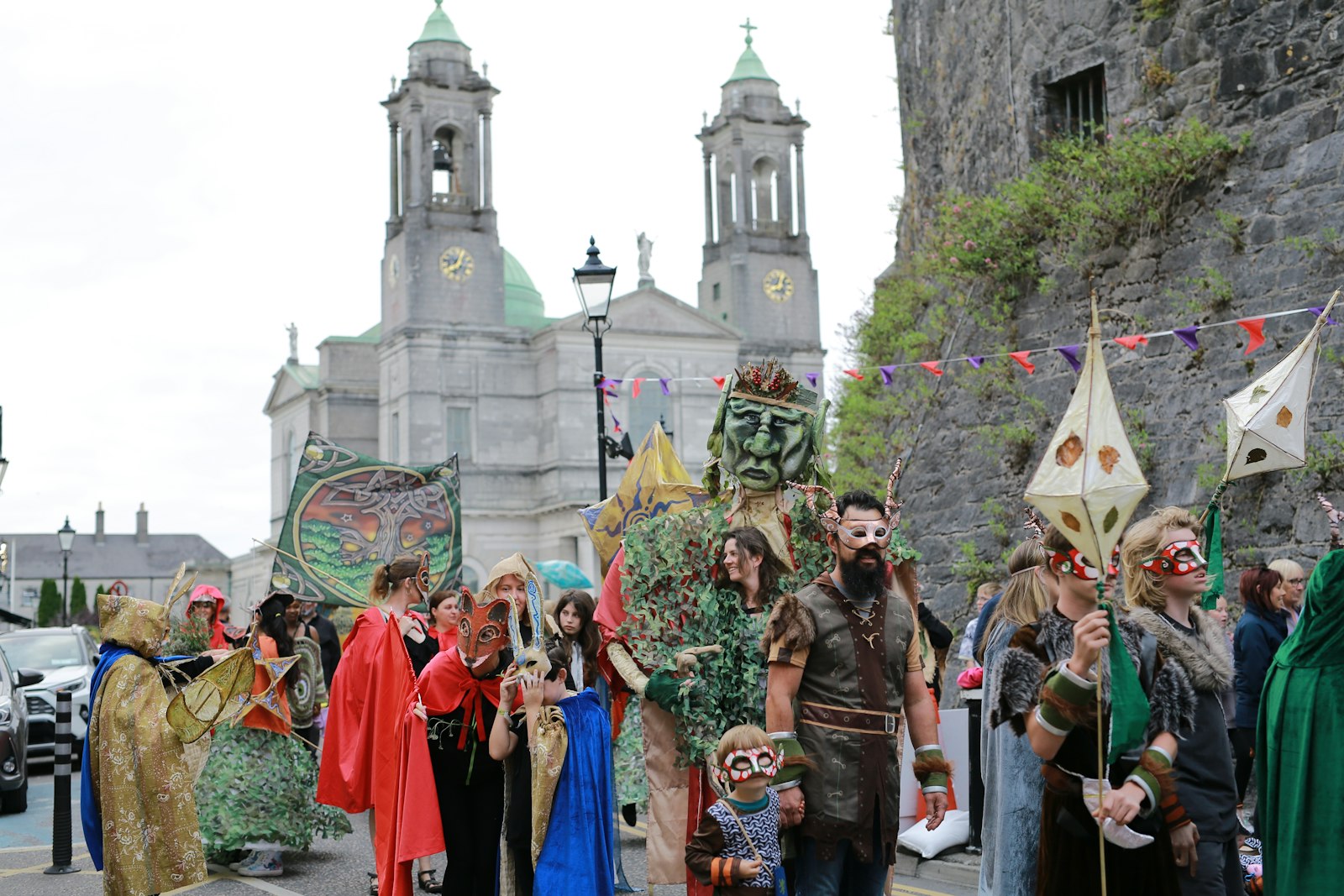
Photo by Marina Nazina on Unsplash
Imagine standing on a hillside in ancient Ireland on the eve of May 1st, surrounded by thousands of people gathered in the flickering darkness of enormous bonfires. The air smells of smoke and animal hides. Cattle are being driven between twin fires in the belief that the flames will protect them for the coming season. A palpable energy fills the night—part celebration, part ritual, part spiritual experience. This was Beltane, one of the four great festivals of the Celtic calendar and arguably the most powerful and transformative of them all.
Where Samhain marked the threshold from summer to winter—a time of withdrawal and introspection—Beltane marked the explosion outward from winter to summer. The name itself comes from the Irish “Bealtaine,” possibly deriving from “Bel,” the name of a Celtic deity, and “teine,” meaning fire. It was the festival of light, growth, fertility, and the rekindling of the world after winter’s dormancy. For ancient Celtic peoples, Beltane wasn’t simply a date on the calendar; it was a moment when the fundamental nature of reality shifted, when the energies of growth and fertility became dominant, when the boundary between the human world and the divine and supernatural worlds grew particularly thin.
Today, Beltane survives in shadowy form in May Day celebrations, in the flowering of spring holidays, in half-remembered traditions that many no longer connect to their origins. But understanding Beltane—its significance, its practices, its meaning—provides profound insight into how ancient peoples understood time, sacred space, and the relationship between human action and cosmic forces. For those drawn to Irish culture and spirituality, Beltane offers a window into a worldview utterly different from modern materialism, a way of seeing the year as cyclical rather than linear, and a sense of humans as participants in vast natural and spiritual rhythms.
The Celtic Calendar and Beltane’s Place Within It
To understand Beltane’s significance, one must first understand the structure of the Celtic calendar and how it differed fundamentally from how modern people experience time. While we divide the year into twelve roughly equal solar months, the ancient Celtic peoples organized their year around four great festivals that marked crucial transitions in the cycles of nature and human society.
These four festivals fell roughly at cross-quarter days—the points halfway between solstices and equinoxes. Beltane (May 1st) marked the beginning of summer. Lughnasadh (August 1st) marked the beginning of the harvest season. Samhain (November 1st) marked the beginning of the dark season and new year. Imbolc (February 1st) marked the first stirrings of spring and the lambing season. Between these four anchor points, the year was organized, the agricultural and pastoral cycles planned, and the relationship between human communities and the supernatural forces believed to govern nature was negotiated and renewed.
Beltane’s specific place in this calendar was crucial. It marked the transition from the dark half of the year to the light half, from the cold months when animals were kept close and fires burned indoors to the warm months when herds could be driven to summer pastures and outdoor activity dominated. This transition wasn’t merely practical; it was spiritual and cosmological. In Celtic understanding, there were two competing forces or seasons in constant tension: darkness and light, cold and warmth, scarcity and plenty, the time of going inward and the time of going outward. Beltane was the moment when light defeated darkness and summer defeated winter.
What made this transition particularly important was that it wasn’t automatic. The ancient Celts didn’t believe that seasons changed simply because astronomical positions shifted. Rather, they believed that active ritual and human participation were necessary to ensure that summer would come, that the herds would multiply, that the earth would again become fertile. Beltane was the ritual occasion when these necessary actions took place. Through the actions performed on Beltane night, the community participated in ensuring the continuation of the seasonal cycle and the perpetuation of the world itself.
The Ritual Practices: Fire, Fertility, and Cosmic Renewal
Beltane rituals centered above all on fire. The most famous Beltane practice involved the lighting of great bonfires, often on hilltops visible across the landscape. These weren’t small domestic fires but massive conflagrations, maintained communally and requiring significant preparation and resources. In some accounts, the Beltane fires were so important that they were tended to throughout the year, kept burning continuously in sacred places and rekindled from existing flames rather than created anew each year.
The purpose of these fires was multi-layered. Practically, as herds prepared to move to summer pastures, the fires provided a way to mark cattle with their heat (a form of branding), to drive out parasites, and to provide smoke that was believed to have protective and purifying properties. The cattle would be driven between two Beltane fires or walked through the smoke, a practice called “teining” that was believed to protect them from disease and ensure their fertility and growth through the summer.
But the significance of the fires was far more than practical. In Celtic religious understanding, fire was a purifying and transformative element. Fire consumed the old and created the new. Fire was the element most closely associated with the divine realm. By creating and controlling these massive fires, the community was engaging in an act of cosmological significance. They were participating in the defeat of winter, the establishment of summer, the renewal of the world’s fertility. The Beltane fires were understood as a communication with the divine forces that governed growth and fertility, a kind of cosmic lever that had to be pulled to ensure the continuation of prosperity and life.
Divination was another important Beltane practice. While Samhain was associated with divination about death and misfortune, Beltane divinations focused on fertility, prosperity, and fortune in the coming season. People would perform various divinations attempting to predict their romantic prospects, the health of their herds, the success of the coming year. Some divinations specifically involved the Beltane fires: objects would be thrown into the flames and their fate observed; or people would jump over the fires (smaller domestic fires rather than the huge hilltop bonfires), and the height of their jump or success in clearing the flames was interpreted as a sign of their fortune.
Fertility rites were central to Beltane. In some regions and periods, couples would engage in sexual encounters that were part of the sacred ritual of the festival, understood as sympathetic magic that encouraged the earth’s fertility. These weren’t seen as immoral but as sacred participation in ensuring the continuation of life and abundance. More broadly, Beltane was associated with abundance, growth, sexuality, and the life force. It was a festival that celebrated the reproductive capacity of the earth, animals, and humans.
The consumption of specific foods was part of Beltane practice, foods particularly associated with summer abundance: dairy products (as cows began producing more milk), fresh meat, and foods that symbolized growth. There was also a specific drink associated with Beltane: mead, honey-based alcohol that represented sweetness and the fruits of prosperity.
The Supernatural Dimension: The Thinning Veil
Like all the great Celtic festivals, Beltane was understood as a time when the boundary between the human world and the supernatural—the world of gods, spirits, fairies, and the dead—became thin and permeable. While Samhain was particularly associated with the dead, Beltane’s supernatural activity centered more on the fairies and other nature spirits, beings understood as powerful, amoral, and potentially dangerous.
On Beltane night, it was believed that supernatural beings were particularly active and visible. Humans needed to be careful: a fairy could steal a human; a person could be taken into the fairy realm and lose years of time; dangerous supernatural creatures could attack livestock or people. To protect against these dangers, various protective practices were performed. Iron, particularly horseshoes, was placed around the home as protection against fairy theft. Certain plants, particularly rowan and primrose, were gathered and displayed or worn as protection. Some communities created barriers of fire (the Beltane fires themselves serving this purpose) as a protective perimeter against supernatural intrusion.
But alongside the danger came the possibility of communication. Beltane was believed to be a time when the veil between worlds was thin enough that humans could communicate with divine and supernatural forces, gain knowledge from them, and receive blessings. This is why divination was particularly powerful on Beltane night, why fertility rites were performed (in sympathetic magic relationship with the divine forces of growth), and why Beltane rituals required such careful choreography and execution. The stakes were high: the proper performance of Beltane rituals could ensure prosperity and protection; improper performance could leave the community vulnerable to supernatural harm and the failure of crops and herds.
The Historical Evidence: Samhain and Beltane in Irish Texts
Our understanding of Beltane comes from several sources, each of which provides fragmentary but consistent information. Medieval Irish Christian monks recorded references to pre-Christian Beltane practices in their texts, often with evident disapproval of pagan customs. Irish mythology preserves references to Beltane, and many of the great mythological tales and adventures in Irish literature take place at Beltane or are timed to coincide with the festival, suggesting its significance in Celtic imagination.
One of the most important historical sources is the “Metrical Dindshenchas” (folklore of place names), a medieval Irish text that describes various sites and their associated stories. Multiple entries in the Dindshenchas describe Beltane rituals, particularly the lighting of the great bonfires and the driving of cattle between them. Archaeological evidence supports some of these descriptions: hilltop sites that seem to have been used for ritual purposes show evidence of ceremonial fires that may have been associated with Beltane.
Irish legal texts from the medieval period, when Ireland was Christian but retain much older material, describe Beltane practices and attempt to regulate them. That medieval Christian authorities felt compelled to legislate against specific Beltane practices suggests that they were widespread and resistant to suppression—people continued to perform them even after Christianity became the official religion.
One particular account, from the medieval Irish text “Cóir Anmann” (Fitness of Names), associates Beltane specifically with fire and fertility, describing the Beltane fires as protective magic performed to ensure the health of cattle: “The druids of Ireland used to make two fires with spells for the protection of the herds…and it was a pagan custom.” The very fact that this practice was called out as “pagan custom” suggests how central and persistent it was.
Beltane’s Evolution: From Celtic Ritual to Medieval Practice to Modern Tradition
When Christianity arrived in Ireland in the 5th century, it faced the same challenge with Beltane as with other Celtic festivals: the festival was deeply embedded in people’s understanding of the year, their spiritual practice, and their community identity. Rather than attempting wholesale suppression, the Church worked to Christianize Beltane, reinterpreting its meaning while allowing its fundamental structure and many of its practices to continue.
This Christianization was less successful than it was with Samhain/Halloween. There was no major Christian saint’s day that naturally aligned with May 1st, so there was less of a framework within which to absorb Beltane into Christian practice. Instead, Beltane continued as a cultural celebration, increasingly secularized and stripped of explicit religious meaning, but still observed as a significant day.
The bonfires continued. In medieval Ireland and into early modern times, Beltane fires were still lit, still used as a marker of the transition into summer, still employed for various protective and fertility purposes. The fires became more explicitly associated with May Day celebrations, with the pleasure of welcoming summer, with the beginning of outdoor season. The explicitly pagan and supernatural elements faded—less emphasis on the thinning veil between worlds, less understanding of the fires as cosmic ritual—but the practice itself persisted.
By the medieval period, other May 1st traditions had become associated with Beltane, creating a more complex holiday. The gathering of greenery (flowers, branches, leaves) became a May Day tradition, which may have derived from Beltane’s association with growth and fertility. The May Pole—a decorated pole around which people would dance—became associated with May Day, though its connection to ancient Beltane is unclear (and is in fact debated by scholars). Feasting and celebrating became the primary mode of Beltane observance, with the festival becoming more secular and less explicitly spiritual.
In Ireland, Beltane continued to be observed into the modern era, particularly in rural areas where older traditions persisted. It was recognized as a significant day, even if its deeper significance had been largely forgotten. In the 19th and 20th centuries, as Irish culture was increasingly documented and preserved (partly out of awareness that rapid social changes were erasing traditional practices), Beltane was recorded in folklore collections. People could remember that May 1st was special, that fires were built, that certain practices and taboos were associated with it, even if the underlying cosmological understanding of the festival had been lost.
The Modern Pagan Revival: Beltane Reclaimed and Reimagined
In the late 20th century, as modern paganism and Wicca emerged as religious movements, Beltane was adopted as one of the eight major sabbats of the pagan year. Modern pagans, seeking to reconstruct or reimagine ancient religious practices, drew on historical sources, folklore, and creative reconstruction to develop contemporary Beltane celebrations.
Modern Beltane rituals, as practiced by pagans today, retain many elements that likely connect to ancient practice: bonfires remain central, divination is performed, fertility is celebrated, and there’s an emphasis on the threshold between seasons and worlds. But modern Beltane also incorporates elements that are distinctly contemporary—explicit goddess-centered spirituality, environmental consciousness, queer-affirming sexuality, and feminist reinterpretations of ancient fertility symbolism.
One of the largest and most famous modern Beltane celebrations is the Beltane Fire Festival, held annually on the extinct volcano of Calton Hill in Edinburgh, Scotland. This event, which began in 1988, draws thousands of participants in elaborate costumes and face paint, combines elements of ancient Beltane practice with modern theatrical performance, and represents how Beltane has been transformed into a contemporary public celebration. The festival has essentially created a new Beltane tradition, one that wouldn’t be entirely recognizable to ancient Celts but that claims connection to that ancient practice.
In Ireland, there has been a modest revival of interest in Beltane among those interested in reconstructing Celtic spirituality. Some communities light Beltane fires on hilltops, particularly in areas with strong cultural pride in Irish heritage. These modern Beltane celebrations are typically smaller and less theatrical than the Edinburgh event, more focused on historical accuracy and spiritual practice, but they serve a similar purpose: reconnecting contemporary people with an ancient festival and understanding it as a moment of spiritual and seasonal significance.
Beltane in the Modern Calendar: May Day
For most people in English-speaking countries, May 1st is known as May Day, associated with flowers, spring celebrations, the May Pole, and various secular festivities. The connection to ancient Beltane has been largely forgotten in mainstream culture. Yet the traces remain: the May Day celebrations in some communities still involve bonfires (though often smaller and more symbolic than the ancient ones); the celebration of fertility and the beginning of summer remains present; the sense that May 1st marks a significant threshold in the year persists.
May Day in various countries has evolved differently. In the United States, May Day is relatively minor, though it’s recognized as a day associated with spring and flowers. In Britain, May Day has developed into a bank holiday with various local traditions. In socialist countries, May 1st became International Labor Day, a political holiday celebrating workers. In Ireland and Scotland, particularly in areas with strong cultural consciousness, May Day retains more connection to its Beltane roots, with some communities maintaining or reviving Beltane fire traditions.
The transformation of Beltane into May Day represents how ancient festivals can become transformed, secularized, and ultimately forgotten in their original meaning while persisting in form. The bones of the ancient festival remain: the date, the association with summer and growth, the celebration of community, even in some places the bonfires. But the cosmological significance, the understanding of this as a crucial moment in humanity’s interaction with divine forces, the sense that ritual action here has consequences for the entire year’s fertility—this has largely vanished from mainstream consciousness.
The Cosmology Behind Beltane: Understanding the Ancient Worldview
To truly understand Beltane, one must step outside modern rational materialism and enter the worldview of ancient Celtic peoples. For them, the natural world wasn’t independent of human action; it was intimately connected through ritual, reciprocity, and participation. Humans didn’t simply exist in nature; they participated in its ongoing creation and renewal.
In this worldview, the sun didn’t simply move across the sky according to astronomical laws; it moved because of the ritual actions performed by humans. The seasons didn’t change because of the Earth’s axial tilt; they changed because the community performed the necessary rituals at the critical thresholds. Cattle didn’t conceive and bear calves simply because of biological reproduction; they did so because humans had performed the fertility rites that sympathetically encouraged their fertility. The harvest happened not just because seeds had been planted and grown, but because the community had performed the rituals necessary to ensure divine blessing and protection.
This wasn’t magical thinking in the modern sense of believing in supernatural effects without rational cause. Rather, it was a comprehensive understanding of the world as animated by divine forces, of humans as participants in these divine forces, and of ritual as the primary means of maintaining the relationship between human community and divine reality. From this perspective, Beltane wasn’t a quaint cultural celebration; it was a cosmological necessity, an act upon which the continuation of the world depended.
Conclusion: Beltane and the Human Need for Sacred Time
The survival of Beltane—in fragmented form, through folklore, in modern pagan practice, and dimly in May Day celebrations—demonstrates something profound about human nature. Across cultures and centuries, humans have felt the need to mark certain thresholds as sacred, to create rituals that acknowledge our participation in larger natural and cosmic cycles, to gather communally at moments of seasonal and spiritual significance.
Modern people often feel disconnected from natural cycles. We live in climate-controlled spaces, lit by artificial light, eating food shipped from distant places regardless of season. We’ve largely lost the sense of profound interdependence with the natural world that characterized agricultural societies. Yet the impulse persists. People are drawn to celebrate spring, to gather at significant dates, to mark seasonal transitions.
Beltane, recovered and reimagined through modern pagan practice, offers one way of reconnecting with this deeper rhythm. Whether celebrated in ancient hillside fires or modern theatrical performances on volcanic hills, Beltane represents the human desire to honor seasons, to celebrate growth and fertility, to participate in rituals that connect us to something larger than individual life. The specific form may change, but the underlying impulse—to recognize certain thresholds as sacred, to gather communally, to acknowledge the forces of growth and renewal—remains vital.
For Americans interested in Irish heritage, Beltane offers insight into how their Irish ancestors understood the world, experienced time, and participated in the sacred. It reveals a cosmology utterly different from modern materialism, yet one that in some ways speaks to contemporary spiritual seeking. And it demonstrates how ancient traditions, even when largely forgotten, can be recovered, reimagined, and find new life in contemporary practice. Beltane persists, transformed but recognizable, a thread connecting modern practitioners back across centuries to those ancient hillsides where communities gathered to light fires and ensure the world’s renewal.

Author: jonathan
Jonathan is the publisher of Irishtopia.net, Anglotopia.net, and Londontopia.net. He's passionate about travel and learning about other cultures. He's been to Ireland several times, and uses his travel expertise for Irishtopia!