
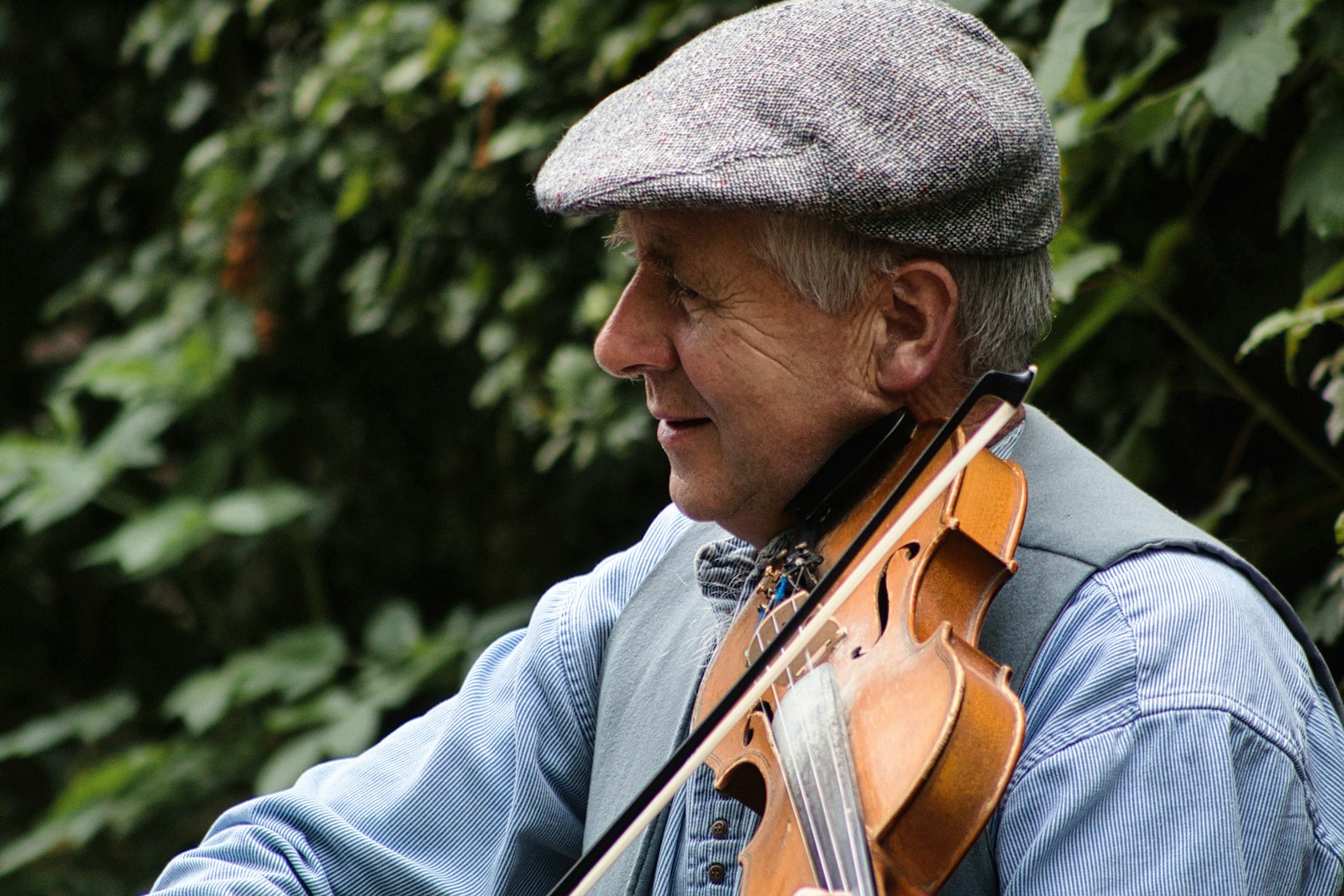
Photo by Torben Gettermann on Unsplash
Introduction
In traditional Irish music sessions—those informal gatherings in pubs, kitchens, and concert halls where musicians play together without rehearsal or formal structure—the fiddle is invariably at the center. The fiddle (essentially a violin played in Irish traditional style) is the primary melodic instrument of Irish traditional music, the instrument around which other musicians orient themselves, the sound that most people associate with Irish music itself.
For Americans hearing Irish music for the first time, the fiddle is usually what captures attention. Its bright, piercing tone can cut through room noise and draw listeners in. Its technical complexity and ornamentation demand respect. Its emotional expressiveness conveys joy, sadness, and everything in between. The fiddle is simultaneously the most essential instrument in Irish traditional music and the most demanding, requiring both technical mastery and deep cultural knowledge.
Understanding Irish traditional fiddle means understanding something essential about Irish culture: its connection to community, its emphasis on interpersonal connection through music, and its belief that beautiful music emerges from shared cultural knowledge and commitment to tradition. Yet it also means understanding how tradition can evolve, how ancient music can remain contemporary, and how individual musicians can bring personal vision to community practices.
History and Origins: Violin to Fiddle
The fiddle is essentially a violin, but the distinction between “violin” and “fiddle” reflects different musical traditions and approaches. Violins were adopted into Ireland through European contact, but Irish musicians adapted the instrument to their own musical traditions and aesthetic preferences. Over centuries, Irish musicians developed distinctive techniques, tuning systems, ornamentation approaches, and repertoires that made Irish fiddle distinct from classical violin or other folk fiddle traditions.
The earliest recorded evidence of fiddles in Ireland dates to medieval times, though the instrument became increasingly prominent over subsequent centuries. By the 18th and 19th centuries, the fiddle was central to Irish musical culture, played by both rural musicians and urban performers. The instrument transcended class boundaries—peasants played fiddles, and so did the gentry, creating a shared musical culture across social divisions.
The development of Irish fiddle traditions was influenced by various factors: contact with other musical traditions, the invention of new repertoires, the evolution of playing techniques, and individual musicians’ innovations. Unlike classical violin traditions, which emphasized formal training and adherence to established standards, Irish fiddle traditions emphasized oral transmission, regional variation, and individual interpretation within shared frameworks.
Regional Styles: Donegal, Sligo, Clare, and Beyond
One of the most distinctive features of Irish fiddle tradition is its regional variation. Different areas of Ireland developed distinctive fiddle styles, reflecting local preferences, influential musicians, and regional musical characteristics. Understanding these regional styles is crucial to appreciating Irish fiddle complexity.
Donegal fiddle style, from the northern county, emphasizes ornamentation and rhythmic complexity. Donegal fiddlers are known for elaborate bowing techniques, extensive use of grace notes and embellishments, and a particular approach to rhythm that emphasizes swing and drive. Players like Francie Mooney and the many Donegal musicians have influenced fiddle playing across Ireland and internationally.
Sligo style, from the northwestern county, emphasizes lyrical playing and sweet tone. Sligo fiddlers tend toward relatively straightforward ornamentation and emphasize melodic beauty. The style is associated with musicians like Michael Coleman, whose recordings in the early 20th century established Sligo style as one of Irish fiddle’s most important regional traditions. Sligo style became particularly influential in America, where it was transmitted through recordings and immigrant musicians.
Clare style, from the southwestern county known for traditional music vitality, emphasizes rhythmic drive and ornamentation. Clare fiddlers developed a sophisticated approach to rhythm that influenced how subsequent generations thought about Irish music. The style is associated with musicians like Paddy Moloney (not the Chieftains’ leader, but an earlier Clare fiddler) and Kitty O’Flannery.
Beyond these major regional styles, nearly every county in Ireland developed its own distinctive fiddle traditions. These regional variations weren’t simply superficial differences but represented genuine aesthetic and technical distinctions. A knowledgeable listener could often identify a fiddler’s likely county of origin by their playing style.
The Ornamentation: Technical Beauty and Musical Meaning
What distinguishes Irish fiddle from violin or other fiddle traditions is its approach to ornamentation. Irish fiddlers use extensive ornaments—grace notes, rolls, cuts, and other embellishments—that modify the basic melodic line. These aren’t simply decorative flourishes but integral to how the music functions.
The ornaments serve multiple functions. They provide variation within the repetitive structure of traditional tunes, preventing exact repetition from becoming boring. They reflect individual musician interpretation and regional style. They require and demonstrate technical mastery. Yet they also have rhythmic and musical functions, affecting how the music flows and how listeners hear the melodic line.
Understanding Irish fiddle ornamentation requires engagement with the tradition’s technical complexity. Different ornaments have specific names and conventional approaches. Yet within these conventions, individual musicians develop personal approaches, creating variation within consistency. A skilled fiddler can recognize ornament usage that distinguishes one musician from another, in the same way that people recognize individual handwriting.
The ornamentation tradition demonstrates that Irish fiddle isn’t simply about playing notes correctly. Instead, it’s about interpretation, expression, and bringing personal musicianship to traditional material. Even while playing centuries-old tunes, each musician brings something individual. This balance between tradition and individual interpretation characterizes Irish musical culture more broadly.
Bowing Techniques: The Physicality of the Instrument
While melody is crucial to Irish fiddle, bowing techniques are equally important. How a fiddler uses the bow—the direction of bowing, the length of bow, the pressure applied, the speed—fundamentally affects the music’s character and expression.
Irish fiddle bowing differs from classical violin bowing in significant ways. Irish fiddlers tend to use shorter bow strokes, emphasizing articulation and definition. The bow movement often emphasizes upbeats rather than downbeats, creating a distinctive rhythmic feel. Regional styles emphasize different bowing approaches, so a Donegal fiddler’s bowing will differ from a Clare fiddler’s approach.
Bowing technique is partly learned through instruction but largely internalized through listening and imitation. Young fiddlers learn by listening to experienced musicians and reproducing what they hear. Over time, they develop their own bowing approaches while maintaining connection to traditional practices. This learning process emphasizes the intimate, interpersonal nature of Irish musical transmission.
The Repertoire: Jigs, Reels, and Everything Between
Irish traditional music’s repertoire consists primarily of instrumental dance tunes: jigs, reels, polkas, hornpipes, marches, and other forms. Each has particular rhythmic and structural characteristics. Jigs emphasize triple meter (compound duple meter, to be technically precise), creating a lilting, bouncing quality. Reels emphasize duple meter, creating a driving, forward-moving feel. Other forms have their own characteristics.
The fiddle plays these tunes with ornamentation and interpretation while maintaining their essential character. A skilled fiddler can ornament a reel without losing its driving quality or a jig without losing its lilting feel. This balance between interpretation and maintaining form’s essential character takes years to develop.
The repertoire exists in a state of constant growth and evolution. While many tunes have been played for centuries and exist in published collections, musicians continue learning tunes from older musicians, composing new tunes that follow traditional patterns, and arranging existing tunes in new ways. The tradition lives through this combination of preservation and innovation.
Notable Fiddlers and Individual Styles
Throughout Irish fiddle history, certain musicians achieved particular prominence through their technical mastery, musical innovation, or influence on subsequent generations. Understanding these musicians reveals how individual creativity operates within traditional frameworks.
Michael Coleman (1891-1945) was a Sligo fiddler whose recordings in America established Sligo style as a major influence in Irish-American communities. His recordings, made in the 1920s and 1930s, became models for how subsequent generations learned Irish fiddle. His influence on American Irish music was profound and continues today.
Paddy Moloney (different from the Chieftains’ leader) was a Clare fiddler whose playing influenced Clare style development. His approach to rhythm and ornamentation became models for subsequent Clare musicians.
Liz Carroll, a contemporary American-Irish fiddler from Chicago, represents how Irish fiddle traditions have been transmitted and sustained in America. Her mastery of Irish tradition and her willingness to compose new tunes while respecting traditional frameworks demonstrates how tradition remains vital through engagement with individual creativity.
Martin Hayes is a contemporary Irish fiddler whose performances demonstrate the emotional depth and expressive potential of the instrument. Hayes performs traditional tunes with deep musicality, showing audiences that Irish fiddle can be a vehicle for profound artistic expression and emotional communication.
The Session: Where Fiddle Lives
The informal session remains the primary context where Irish fiddle is played. Sessions typically occur in pubs, where musicians gather to play traditional tunes together. The session structure is remarkably democratic—there’s no conductor, no predetermined list of who will play. Instead, musicians gather in a circle, one person starts a tune, others join in if they know it, and the group plays the tune through, usually twice.
In sessions, the fiddle typically carries the melody while other instruments—bodhrán, bodhran, guitar, bouzouki—provide accompaniment or countermelodies. The fiddler’s role is to maintain the tune’s character while being responsive to the group’s energy and variations. Good session fiddlers know how to balance carrying the tune with being part of a group, maintaining the tune’s integrity while allowing for individual expression.
Sessions represent Irish music’s most authentic context. While concert performances and recordings are important, the session represents how Irish musicians actually play together. Sessions emphasize participation over performance, community over individual achievement, and the joy of making music together over commercial success.
For Americans learning Irish fiddle, understanding the session context is crucial. Irish fiddle isn’t primarily about individual achievement or technical display. Instead, it’s about community participation and shared cultural knowledge. A fiddle player who can dazzle audiences with technical prowess but can’t participate appropriately in a session is missing something essential to the tradition.
Learning Irish Fiddle: Tradition and Transmission
Traditionally, Irish fiddle was learned entirely through oral transmission. Young musicians learned by listening to experienced players, imitating what they heard, and gradually developing their own approach within traditional frameworks. This learning process created deep cultural understanding and intimate connection to tradition.
In contemporary times, this oral transmission continues, but it’s supplemented by formal instruction, published collections of tunes, and recordings. Young people can learn Irish fiddle through private lessons with established musicians, through workshops and camps dedicated to Irish music, and through community music programs.
What remains constant across learning approaches is the emphasis on listening and imitation. While reading music notation can supplement learning, the core of Irish fiddle learning involves listening closely to experienced musicians and reproducing what you hear. This approach develops skills and understanding that notation alone cannot convey.
Contemporary Irish Fiddle: Evolution and Vitality
Contemporary Irish fiddle traditions remain vital and evolving. Young musicians continue learning traditional repertoires and playing in sessions. Simultaneously, they compose new tunes, explore fusion approaches, and find ways to keep the tradition contemporary and relevant.
Some contemporary fiddlers, like Francie Mooney or Martin Hayes, have achieved significant international recognition while remaining rooted in traditional practice. Others have experimented with fiddle in non-traditional contexts, incorporating Irish fiddle into fusion projects, classical compositions, and other musical forms. These experiments don’t diminish the tradition but demonstrate its flexibility and adaptability.
Contemporary Irish music education has become more formalized, with university programs and specialized schools teaching Irish music. This formalization has both benefits and potential costs—it preserves and transmits knowledge, but it also risks professionalizing and commodifying music that traditionally emphasized amateur participation and community engagement.
The Fiddle in American Irish Culture
Irish fiddle has had profound impact on American music culture, particularly in Irish-American communities. Immigrant musicians brought their instruments and repertoires to America, establishing Irish music traditions that have remained vital for over a century. Irish sessions continue in American cities with significant Irish populations, and new generations of Americans of Irish descent continue learning and playing Irish fiddle.
The fiddle has also influenced broader American musical traditions. Country music, bluegrass, and other folk traditions have incorporated elements from Irish fiddle. The technical and aesthetic approaches of Irish fiddling have influenced how American musicians think about their own instrumental traditions.
Conclusion: An Essential Voice
The Irish fiddle represents something essential about Irish culture: the belief that beautiful, expressive music can emerge from community participation, that tradition can remain vital through engagement and evolution, and that shared cultural knowledge creates bonds connecting people across time and circumstance.
For Americans interested in Irish music, the fiddle is essential listening. Whether you encounter it in traditional sessions, concert settings, or fusion contexts, the fiddle’s distinctive voice speaks to something deep in human experience. Its beauty and technical sophistication demand respect. Its rootedness in community and tradition offers lessons about how culture is preserved and transmitted. Its contemporary vitality demonstrates that tradition doesn’t require stasis but thrives through engagement, evolution, and the commitment of musicians and communities to keeping the music alive.
Listen to Irish traditional fiddle, and you’re encountering not just beautiful music but a different philosophy of what music means, how it’s created, and what purposes it serves. You’re participating in a tradition stretching back centuries while remaining vibrantly alive in the present moment.
Keywords: Irish fiddle, traditional Irish music, violin, regional styles, Donegal, Sligo, Clare, ornamentation, bowing techniques, trad sessions, Irish musicians, folk music, cultural transmission

Author: jonathan
Jonathan is the publisher of Irishtopia.net, Anglotopia.net, and Londontopia.net. He's passionate about travel and learning about other cultures. He's been to Ireland several times, and uses his travel expertise for Irishtopia!