
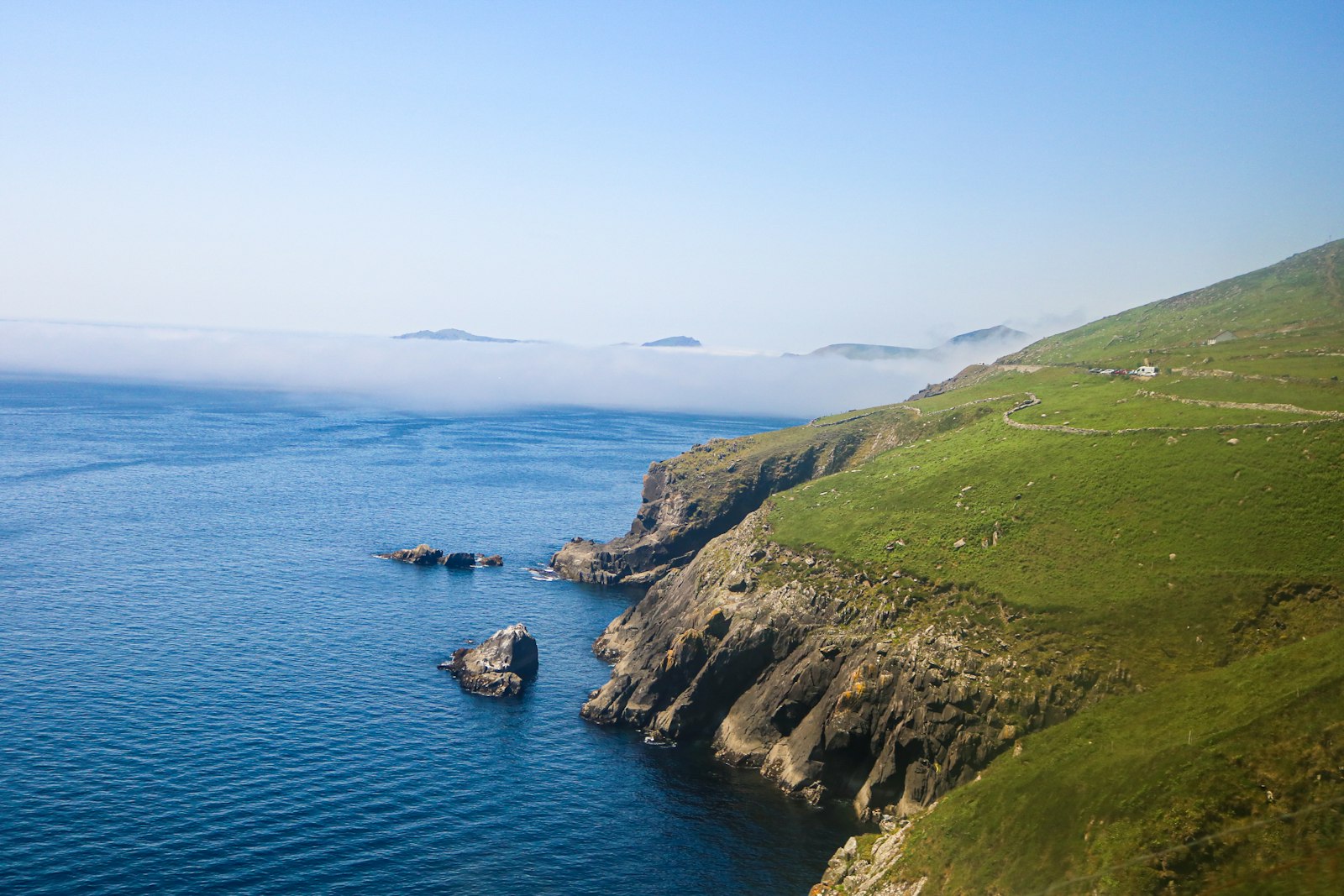
Photo by Dahlia E. Akhaine on Unsplash
The Dingle Peninsula, jutting westward into the Atlantic like a pointing finger, represents one of Ireland’s most enchanting destinations. This wild, windswept landscape in County Kerry combines dramatic coastal scenery, charming villages, ancient archaeological sites, and some of Ireland’s finest traditional music and food scenes into a concentrated area. For American visitors seeking Ireland’s authentic character without sacrificing natural beauty, the Dingle Peninsula delivers everything and more.
What makes Dingle special transcends its individual attractions. It’s the cumulative effect of narrow roads winding past sheep-dotted hillsides, tiny villages with centuries of history embedded in their stone structures, beaches where turquoise water seems impossibly vivid, and a cultural identity so strong that Irish remains the primary language. Visiting Dingle feels like stepping into Ireland as visitors imagine it—not as some preserved museum piece, but as a living, breathing place where traditions persist because communities choose to maintain them.
Understanding Dingle’s Geography and Layout
The Dingle Peninsula extends approximately 48 kilometers from the base near Annascaul to its western extremity at Dunquin. Despite its length, the peninsula remains narrow—never exceeding 10 kilometers in width. This compact geography means that most major attractions are accessible within 30-45 minutes driving from any location on the peninsula, making it perfectly suited to touring and exploration.
The peninsula’s primary route is the R559, which travels from Dingle town (the regional hub) westward to Dunquin. Secondary roads wind through the peninsula’s interior, connecting smaller villages and providing alternative routes. The peninsula’s famous single-lane roads, locals call “boreens,” were originally used by farmers and remain navigable but require careful driving and an understanding that pulling over for oncoming traffic is expected courtesy.
The peninsula divides naturally into three regions: the eastern section near Dingle town and its immediate surroundings, the central highland region featuring Conor Pass and Connor Heights, and the western section beyond Dunquin extending to ancient archaeological sites and the westernmost inhabited places in Ireland.
Dingle Town: The Peninsula’s Heart and Soul
Dingle town (Pop Dín—Fortress of the Dingle) serves as the peninsula’s cultural and commercial hub. A working fishing port with genuine character, the town eschews theme-park atmosphere despite receiving thousands of visitors annually. The harbor remains active with fishing boats, their catches sold in fish markets and restaurants throughout town. This working-harbor authenticity distinguishes Dingle from many other Irish coastal towns.
The town’s appeal stems largely from its independent spirit. Walking Main Street reveals independent shops rather than chain stores, restaurants emphasizing local fish and traditional cooking, and pubs maintaining live traditional music as genuine gatherings rather than tourist performances. The town supports an artistic community, with galleries and studios interspersed between commercial establishments.
The harbor walk provides Dingle’s essential orientation point. This waterfront path, accessible at various points throughout the town, offers views of working boats, the harbor’s dramatic landscape, and weather patterns that frequently shift between brilliant sunshine and moody atmospheric conditions within minutes. The harbor becomes particularly photogenic at sunset when fishing boats and harbor buildings receive golden illumination.
Cultural Attractions in Dingle
The Dingle Dolphin Centre documents the presence of Fungie, the wild dolphin who has made Dingle harbor home since the 1980s. While Fungie’s presence raises ethical questions about wildlife tourism, the center provides historical context and educational information. Boat tours departing from the harbor offer chances to observe Fungie, though wildlife enthusiasts should understand that wild animals don’t perform on schedules—sightings aren’t guaranteed.
The Dingle Distillery produces gin and whiskey using local water and botanicals. Tours of this working distillery combine education about spirits production with tastings. The distillery’s modern facility sits within a historic building, blending contemporary operation with architectural heritage.
Dingle’s numerous pubs warrant exploration beyond casual visits. Foxy John’s, despite its tourist reputation, maintains authentic character and often hosts traditional music. The Thatched Cottage pub preserves genuinely ancient architecture and serves as a meeting point for locals. Aurélio’s runs on the philosophy that pub sessions should be by and for musicians, occurring spontaneously rather than on fixed schedules—this authenticity means occasionally arriving to find no session, but also ensures that performances reflect genuine musical expression rather than tourist entertainment.
Local Dining in Dingle
Dingle’s culinary reputation extends throughout Ireland. Restaurants emphasizing fresh seafood, traditional preparation methods, and local ingredients define the dining scene. A Saor Fheoil (meaning “wild meat” or “game”) focuses on locally sourced ingredients and adventurous preparation. Boatyard operates as both restaurant and bar, with excellent seafood and a vibrant atmosphere.
What distinguishes Dingle dining from other Irish food destinations is the integration of Irish language, cultural pride, and culinary excellence. Many establishments employ Irish names, staff speak Irish fluently, and menus incorporate Irish traditions while maintaining contemporary sophistication.
The Dingle Peninsula Loop: Scenic Driving and Exploration
Most visitors follow the R559 loop that circles the peninsula, creating a full-day or two-day driving experience. This loop encompasses primary attractions while offering genuine scenic beauty regardless of weather conditions—even gray, misty days enhance the landscape’s drama.
Eastern Peninsula: Connor Pass and Mountain Heights
The route from Dingle to Dunquin immediately encounters elevation gain through Connor Pass (Bealachonair in Irish). This mountain pass represents Ireland’s highest road at 456 meters above sea level. The narrow, winding road climbs dramatically through terrain transformed from pastoral farmland into rocky alpine landscape.
At the pass’s highest elevation, pullouts offer continental views across the peninsula. On clear days, visibility extends across Dingle Bay toward County Clare. Even under cloud cover, the dramatic terrain commands attention. The pass itself—navigated by regular buses despite its narrow width—demonstrates both the engineering confidence of Irish road builders and the navigational skills of Irish drivers.
The descent from Connor Pass transitions through landscape changes that rival any drive in Ireland. Within minutes, terrain shifts from exposed mountain terrain to gentle farmland, then to coastal cliffs as the western section approaches.
Central Peninsula: Villages and Island Views
Dunquin, perched on dramatic cliffs overlooking the Atlantic, represents the western peninsula’s cultural heart. Despite its population of fewer than 200 permanent residents, Dunquin maintains cultural significance as an Irish-speaking stronghold and archaeological treasure.
Kruger’s pub, operating since 1887, serves primarily locals and deeply committed travelers. The bar maintains a historical atmosphere with minimal concessions to modernization. Sessions of traditional music occur regularly, with musicians gathering to play together rather than for tourist consumption. The pub’s authentic character, combined with its precarious coastal location, creates an experience many describe as profound.
Dunquin’s harbor area, situated at cliff base reached via a narrow road, provides access to views of the Blasket Islands. These uninhabited islands, formerly home to thriving Irish-speaking communities, were evacuated in 1953 when the government determined sustainable living had become untenable. The islands’ abandonment occurred within living memory—some Dunquin residents were born on the islands before evacuation.
The Blasket Island Centre, located in Dunquin, documents this community’s culture and history through exhibits, photographs, and personal accounts. The melancholy history—a living culture preserved in museums because the community itself no longer exists—creates profound emotional experiences for visitors.
Dún Chaoin (Dunquin), while tiny, contains the Dún Chaoin Archaeological Site, featuring Early Christian remains dating to the 6th century. The remains, including a small church and associated structures, sit on dramatic coastal terrain where the Atlantic crashes against cliffs. Archaeological significance combines with landscape drama to create location remarkable for both historical and scenic reasons.
Western Peninsula: Ancient Sites and Remote Settlements
Beyond Dunquin, the peninsula’s roads narrow dramatically and traffic diminishes substantially. These are genuine back roads where isolation feels profound and the Atlantic’s presence becomes almost tangible.
Ballyferriter, southwest of Dunquin, contains several archaeological sites representing different historical periods. Dunbeg Fort, an Iron Age promontory fort, occupies a dramatic coastal location where defensive architecture combines with natural geography for protection. The fort’s design—circular stone walls on a peninsula surrounded by cliff faces—demonstrates ancient engineering knowledge.
Riasc Monastery represents Early Christian settlement, with remains including a decorated stone slab bearing geometric patterns. The monastery’s remote location, chosen for spiritual isolation, emphasizes early Christian understanding of sacred geography.
Céardlann an Filiochta (The Poet’s Forge) operates as an artist residence and cultural center promoting Irish culture and traditional arts. The location, deep in the Irish-speaking Gaeltacht region, hosts cultural events and workshops throughout the year.
The landscape itself becomes increasingly dramatic moving westward. Dramatic cliffs, isolated beaches, and scattered cottages create scenery that feels genuinely remote despite remaining accessible by car. The light here takes on qualities photographers describe as exceptional—the Atlantic’s influence creates weather patterns and atmospheric conditions producing luminous effects rare elsewhere.
Slea Head, at peninsula’s southwestern extremity, presents panoramic views encompassing the Dingle Peninsula’s full character. On clear days, visibility extends across Dingle Bay toward the Iveragh Peninsula, toward the Blasket Islands, and across the Atlantic westward. The drive to Slea Head passes through terrain where traditional Irish culture remains visibly alive—landscape signs appear in Irish, place names remain Irish, and the environment itself feels culturally distinct from anglicized Ireland.
Beaches and Coastal Wonders
The Dingle Peninsula contains numerous beaches, each with distinct character. Inch Strand, on the peninsula’s south-facing coast, extends for approximately 5.5 kilometers of golden sand. This Blue Flag beach supports swimming, and in summer months, lifeguards patrol designated swimming areas. The beach maintains a local character despite its size—families with children, surfers riding Atlantic swells, and walkers exploring the shoreline mix with tourists.
Coumenoole Beach, accessed via a scenic drive near Slea Head, presents perhaps the peninsula’s most dramatic beach setting. High cliffs surround golden sand and turquoise water, creating landscape so visually impressive that the beach has featured in numerous films and television productions. The beach, smaller and more sheltered than Inch, attracts fewer visitors and maintains a sense of discovery.
Dunmore Head Beach offers both swimming and surfing, with consistent Atlantic swells making it a destination for experienced surfers. The beach’s rugged beauty combines with visible cultural character—Irish signage, local fishing boats, and the genuine sense of being at Ireland’s westernmost edge.
Murreagh Beach, accessed via a narrow lane near Ventry, remains largely unknown to tourists. This intimate beach, backed by cliffs and home to small fishing communities, retains a sense of genuine remoteness. Walking here, you might encounter only a handful of others, making it feel like a personal discovery.
The Dingle Way: Hiking the Peninsula
For walking enthusiasts, the Dingle Way provides an 176-kilometer hiking trail circumnavigating the entire peninsula. The trail connects villages, passes archaeological sites, and crosses varied terrain from coastal paths to mountain ridges. Most hikers tackle sections rather than completing the full circuit, but even short segments provide excellent walking with landscape beauty and cultural insights.
The section between Dunquin and Slea Head provides perhaps the most dramatic walking. Coastal cliffs, archaeological sites, and sweeping views combine with manageable distance—approximately 14 kilometers—making it accessible to intermediate hikers. Walking this section takes approximately 5-6 hours, providing a full day of immersion in the peninsula’s most dramatic landscape.
Connor Pass offers another excellent hiking option. While drivable, walking the pass provides experiences unobtainable from vehicles. The walking route encompasses approximately 8 kilometers of mountain terrain, offering panoramic views and a genuine sense of alpine landscape in Irish context.
Exploring Beyond the Main Peninsula
Nearby attractions extend Dingle visits and provide alternative experiences. The Slieve Mish Mountains, located south of Dingle, present hiking opportunities through dramatic alpine terrain. The Cloghane and Castlegregorly areas offer quieter villages and walking routes avoiding the main tourist corridor.
Anascaul, south of Dingle, contains the South Pole Inn, a pub with a genuine historical connection. The pub’s proprietor, Tom Crean, was an Antarctic explorer who accompanied Ernest Shackleton. The pub operates as historical document and genuine working bar, with Antarctic memorabilia and personal items preserving this unique history.
The Inch Peninsula Loop provides a scenic drive and walking opportunities with excellent views across Dingle Bay. This quieter route bypasses main attractions but offers landscape beauty and genuine peace.
Practical Information for Dingle Peninsula Visitors
Getting There: Dingle sits approximately 50 kilometers west of Killarney, accessible via the N71 and R562. From Cork city, the journey takes approximately 2 hours. Public transportation reaches Dingle town, but exploring the peninsula fully requires a rental car or organized tours.
Accommodation: Dingle town offers the widest accommodation selection, ranging from budget hostels to luxury hotels. Smaller villages throughout the peninsula contain guesthouses and bed-and-breakfasts offering intimate experiences and often superior value. Booking in advance is essential during July and August.
Dining: Reservations are recommended at established restaurants, particularly in Dingle town. Village pubs throughout the peninsula offer food and often traditional music. Casual dining remains accessible and reasonably priced.
Language: The Dingle Peninsula sits within the Gaeltacht region where Irish is the official language. While English serves for general communication, learning basic Irish phrases shows respect and often improves local interactions. Signage appears primarily in Irish, with English translations.
Weather: Atlantic location ensures variable weather. Visitors should prepare for sudden changes from brilliant sunshine to rain and mist. These weather shifts, rather than being inconveniences, enhance the landscape’s visual drama.
Timing: May through September provides optimal weather and maximum facility availability. Shoulder seasons (April, May, September, October) offer advantages of fewer crowds, pleasant weather, and lower prices. Winter visits are possible but require acceptance of very limited daylight hours and frequently challenging weather.
Costs: Dingle dining and accommodation costs exceed rural Ireland but remain reasonable compared to major American cities. Self-catering options proliferate in villages throughout the peninsula, allowing budget management.
Cultural Immersion in the Dingle Peninsula
What distinguishes the Dingle Peninsula from other Irish destinations is the degree to which visitors can engage with living Irish culture. This isn’t heritage tourism—it’s cultural immersion in a place where Irish language remains genuinely spoken, traditional music persists because communities value it, and cultural practices continue because they hold meaning rather than tourist appeal.
Attending traditional music sessions, dining at locally-owned restaurants, staying in family-run guesthouses, and spending time in village pubs creates connections to Irish life impossible to achieve through conventional tourism. The peninsula’s relative remoteness and strong Irish-speaking identity mean that visitor interactions remain genuine rather than commercially performed.
Conclusion: The Dingle Experience
The Dingle Peninsula offers something increasingly rare in modern tourism—an opportunity to experience a place where natural beauty, cultural authenticity, and human warmth combine without feeling manufactured. The peninsula’s dramatic landscapes compel awe, but its villages and communities provide the human experiences that transform tourism into genuine cultural exchange.
Visiting Dingle means adapting somewhat to Irish pace and accepting that everything doesn’t run with American precision. It means appreciating villages that prioritize community over commercialization, restaurants that emphasize quality over efficiency, and a landscape that changes appearance hourly depending on weather and light conditions.
The Dingle Peninsula rewards visitors who embrace this different rhythm. Those who arrive with typical tourism itineraries and tight schedules may feel frustrated by weather delays or the slower pace of village life. Those who settle into the peninsula’s rhythm, allowing extra time for spontaneous discoveries and genuine interaction, find magic that exceeds their expectations. The difference between visiting Dingle and experiencing it rests largely in this willingness to adapt to a different way of moving through the world.

Author: jonathan
Jonathan is the publisher of Irishtopia.net, Anglotopia.net, and Londontopia.net. He's passionate about travel and learning about other cultures. He's been to Ireland several times, and uses his travel expertise for Irishtopia!