
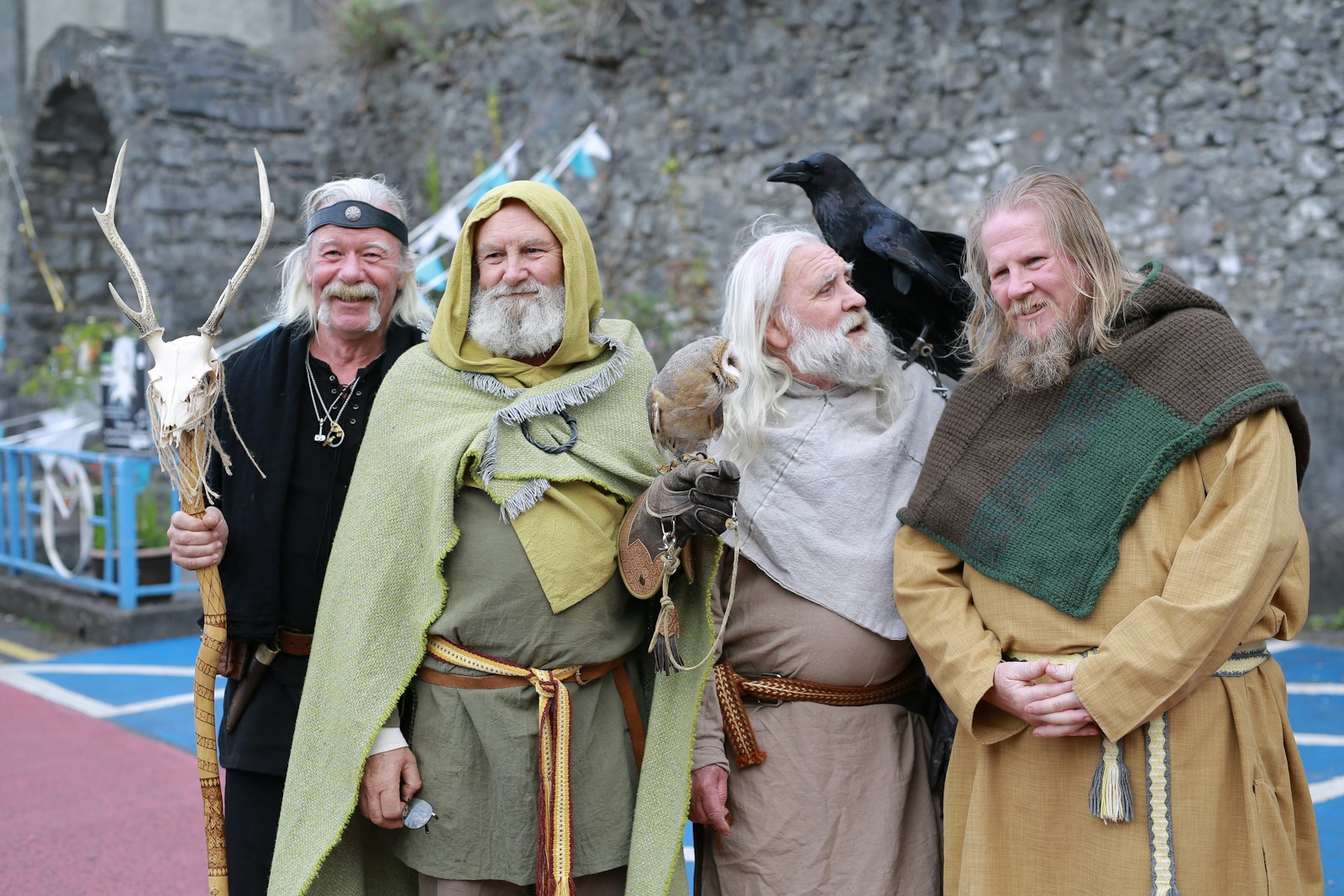
Photo by Marina Nazina on Unsplash
When Vikings arrived at the coast of Ireland in the late 8th century, they initiated a transformation of Irish society that lasted centuries. While popular imagination often focuses on Viking raids and violence, the Viking impact on Ireland was far more complex and extensive. Vikings became not just raiders and destroyers but also settlers, traders, and political actors who fundamentally shaped Irish politics, trade, culture, and the development of towns and urban centers. Understanding the Viking Age in Ireland requires moving beyond simplistic narratives of external invasion to understand how Vikings became integrated into Irish society and how Irish and Viking populations interacted, competed, and sometimes cooperated over the centuries of their coexistence.
The First Raids and Viking Expansion
The Viking raids on Ireland began in 795 with an attack on the monastery of Rathlin Island, off the coast of Ulster. These initial raids were part of the broader Viking expansion that was beginning to affect much of northern Europe at this time. Norse raiders from Scandinavia, motivated by a combination of factors (overpopulation in Scandinavia, the lure of portable wealth in Christian monasteries, the development of navigation and ship-building technology that made ocean voyages feasible), began to range far from their homelands in search of plunder and opportunity.
The early raids on Ireland focused on wealthy and accessible targets, particularly monasteries. These religious communities were attractive targets because they contained precious objects, were often located near coasts or on islands, and had populations of unarmed monks who could not effectively resist. The chronicles, written by monks themselves, record numerous Viking attacks on monasteries in the early 9th century, with accounts that often emphasize the violence and destruction wrought by the raiders.
However, the accounts of contemporary chroniclers should be read with some skepticism. The monks who wrote the chronicles had direct interest in depicting the Vikings as exceptionally barbaric and destructive—doing so emphasized the monks’ own piety and suffering and underlined the necessity of monastic institutions in society. The Viking raids were undoubtedly destructive and resulted in deaths and suffering, but the extent to which they differed from the violence and raiding that characterized inter-Irish conflict is less clear.
The scale of Viking activity expanded over the 9th century. Initially dominated by Norse raiders from Norway, by the middle of the 9th century, Danes (Viking groups from Denmark) also became involved in raids on Ireland. The intensity of raiding fluctuated, with periods of relative calm interspersed with periods of intense raiding. By the middle of the 9th century, Viking forces were not merely conducting raids but were establishing semi-permanent bases in Ireland from which to conduct further raids.
The Establishment of Towns and Trade Centers
An important development in the Viking Age in Ireland was the establishment of permanent Viking settlements and trading posts. The most significant of these were Dublin, Limerick, and Waterford, though smaller settlements also existed at various coastal locations. These Norse settlements eventually developed into towns and became centers of trade.
Dublin, originally a small settlement, grew into the most important Norse settlement in Ireland. By the 10th century, Dublin had become a significant trading port with connections to Viking trading networks extending from the Atlantic to the Mediterranean. Archaeological evidence from Dublin shows that the Norse built houses, established markets, and created a urban community with characteristics distinct from the rural Irish society surrounding them.
These Norse towns served as centers of trade, particularly in goods such as furs, amber, walrus ivory, and other luxury items that came from northern Europe and were traded south. They also became centers of slave trading, an unfortunate but significant part of Viking commerce. Irish people captured in raids or through military conflicts were bought and sold through these markets, exported to Scandinavian slave markets, or retained for labor in Ireland.
The development of these Norse trading towns represented a fundamental change in Irish society. Ireland had never developed significant urban centers in the pre-Viking period; most settlement was rural, consisting of isolated farms, monastic settlements, and small administrative centers for the various local kings. The Norse towns were the first true urban centers in Ireland, with markets, craftspeople, merchants, and a level of commercial organization that Ireland had not previously experienced.
Integration and Intermarriage
Over the course of the 9th, 10th, and 11th centuries, the distinction between Norse and Irish populations gradually blurred through a process of integration. Norse settlers intermarried with Irish women; Irish men served in Viking forces; cultural exchange occurred between the populations. By the 10th century, it becomes less accurate to speak of a fundamental division between “Norse” and “Irish” and more accurate to speak of a mixed population with varying degrees of Norse and Irish heritage.
The process of integration is visible in the historical records. Norse men married Irish women from both common and noble families. The offspring of these unions were raised in a cultural context influenced by both Norse and Irish traditions. Over generations, the cultural distinctiveness of the Norse populations diminished as they adopted Irish language, religion, and customs.
This integration shouldn’t be understood as either the Norse disappearing into Irish culture or Irish culture being overrun by Norse invaders. Rather, it was a complex process of cultural blending in which both populations influenced each other. Norse settlers in Ireland became known as “Hiberno-Norse”—Norse people living in and influenced by Irish context. They maintained some of their Norse identity but became increasingly Irish in their language, religion, and cultural orientation.
Political Involvement and Alliance
As the Viking presence in Ireland became more established and the Norse populations integrated with Irish society, Norse leaders became participants in Irish politics. Norse kings like Olaf Guthfrithson, who ruled Dublin in the early 10th century, operated as political players in the complex Irish political landscape, making alliances with Irish kings, competing for power, and attempting to extend their influence and control.
The extent to which Norse leaders sought to expand their power beyond their coastal settlements is debated by historians. Some attempts at expansion occurred, with Vikings occasionally attacking and conquering Irish territories in the interior. However, for the most part, Norse power remained concentrated in the coastal areas and particularly in the areas surrounding the major Norse towns.
The relationship between Irish and Norse powers was not one of permanent conflict. Irish kings sometimes formed alliances with Norse leaders when it served their political purposes. Irish kings might hire Norse warriors to support them in conflicts with rival Irish powers. Conversely, Norse leaders sometimes assisted Irish kings in return for payment or political advantage.
The most famous military engagement between Irish and Norse forces was the Battle of Clontarf in 1014, where the High King Brian Boru defeated a coalition that included Norse forces from Dublin. This battle is often presented in legend as a triumphant moment when Irish independence was secured and the Norse threat was finally defeated. However, the historical reality was more complex—the battle involved both Irish and Norse forces on both sides, and while it damaged Norse power, it did not result in the expulsion of Norse people from Ireland or the end of Norse political influence.
Economic and Cultural Impact
The Viking Age impact on Ireland extended beyond political and military interaction to fundamental economic and cultural changes. The development of towns and trade networks created new economic opportunities and changed the character of Irish commerce. The Norse introduced new trading goods, new commercial practices, and new connections to continental European trade networks.
The Norse also introduced new maritime technologies and navigational knowledge that improved Irish seafaring capabilities. Over time, Irish people adopted Norse ship-building techniques and maritime practices, improving their own capacity for maritime activity.
Culturally, Norse contact influenced Irish art, language, and material culture. Some Norse vocabulary entered the Irish language, particularly words related to ships, maritime activity, and commerce. Norse art styles influenced Irish artistic traditions. Norse metalworking and crafts influenced Irish craftspeople.
Religiously, the Norse, initially pagan, gradually converted to Christianity as they spent time in Ireland and as Christianity became the dominant religion. By the 10th century, Irish Christianity had influenced the religious beliefs of the Norse populations, though Norse converts sometimes maintained distinctive religious practices and perspectives.
Slave Raiding and Human Trafficking
A darker but important aspect of Viking activity in Ireland was the slave trade. Vikings captured Irish people through raiding and warfare and sold them into slavery, both through Irish Norse settlements and through wider Viking trading networks. The Irish sources record with some frequency the capture and enslavement of Irish people, though the scale of this activity and the numbers involved are difficult to determine precisely.
Slavery in this period was a common practice across medieval Europe, but the Viking slave trade in Ireland created a significant flow of enslaved people. Some were sold to Norse settlements in the Mediterranean or in Spain where they were valued as slaves in Islamic societies. Others were retained in Ireland or sent to Scandinavian settlements. The ability to sell captives into slavery made raiding economically lucrative and contributed to the frequency of Viking activity.
The slave trade also had the effect of raising the price of protection and creating incentives for Irish populations to pay tribute to Norse leaders in exchange for protection from raiding. Some Irish kings paid regular tribute to Norse leaders, effectively acknowledging Norse power in exchange for reduced raiding.
The End of the Viking Age
The Viking Age in Ireland gradually ended not with a dramatic conclusion but through a process of integration and changing historical circumstances. By the 11th century, the period of major Viking expansion was ending. Norse settlements in Ireland became increasingly integrated into Irish society. The distinction between Norse and Irish became less meaningful as mixed populations and cultural blending created a new hybrid population.
The Norman invasion of Ireland in 1170 introduced a new external power to Ireland and brought a new phase of Irish history. By that time, the Norse populations of Ireland had been present and integrated for centuries. Some Norse or Hiberno-Norse families continued to exercise power and influence, but the distinctive Viking Age—the era of external Norse raiders establishing themselves and competing for power—had ended.
Legacy and Significance
The Viking Age in Ireland had profound and lasting consequences. The establishment of Norse towns, particularly Dublin, created the foundation for urbanization in Ireland. The commercial networks established by Norse traders became part of Irish economic life and remained important long after the distinctive Viking Age had ended. The genetic and cultural mixing of Norse and Irish populations created new populations and cultural syntheses.
The Viking Age also connected Ireland more firmly to broader European trade networks and political developments. Ireland, which had been relatively isolated in the pre-Viking period, became connected to Scandinavian, continental European, and Mediterranean trade and politics through its engagement with Viking traders and raiders.
For Irish Americans, the Viking Age represents an important chapter in Irish history that complicates any simple narrative of Irish identity. The Norse influence on Irish culture, the integration of Norse people into Irish society, and the establishment of Viking settlements that became important Irish towns are all part of Irish historical heritage. Many modern Irish people have Norse ancestry, a legacy of the intermarriage and integration that occurred during this period.
The Viking Age in Ireland also demonstrates how a society responds to external invasion and challenge. Rather than being completely destroyed or conquered by external invaders, Irish society absorbed the Viking challenge, integrated Viking people and influences, and ultimately emerged with a new, hybrid character. This resilience and the capacity to adapt to external challenge are themselves part of the Irish historical legacy.

Author: jonathan
Jonathan is the publisher of Irishtopia.net, Anglotopia.net, and Londontopia.net. He's passionate about travel and learning about other cultures. He's been to Ireland several times, and uses his travel expertise for Irishtopia!