
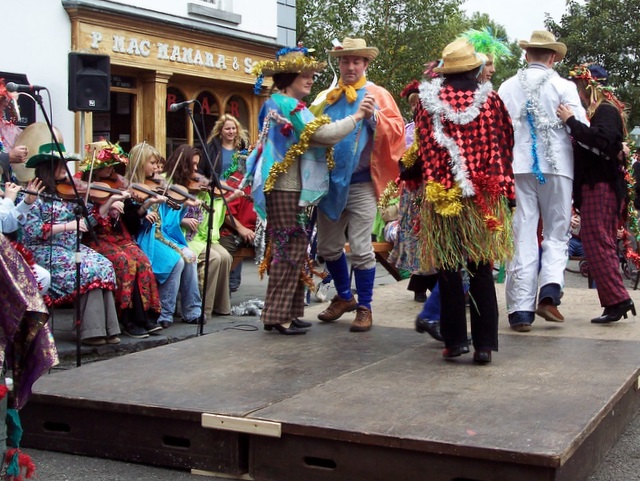
While much of the world winds down after Christmas Day, Ireland springs back to life on December 26th with one of its most peculiar and ancient traditions: the Wren Boys. This custom, also known as “Hunting the Wren” or “Wren Day,” represents one of the most enduring links between Ireland’s pre-Christian past and its modern celebrations.
Origins in Ancient Ireland
The Wren Boys tradition stretches back into the mists of Irish prehistory, with roots that may extend to Celtic pagan practices. In ancient Ireland, the wren was considered the “king of all birds” despite its tiny size, earning respect and significance in Celtic folklore. The bird was associated with druids and was believed to possess prophetic powers.
Various legends attempt to explain why the wren became the target of St. Stephen’s Day hunts. One popular tale claims that a wren betrayed Irish soldiers to Viking invaders by drumming its wings on their shields, alerting the enemy to their position. Another story suggests that a wren’s chattering revealed the location of St. Stephen himself, leading to his martyrdom. A third legend tells of a wren breaking a magical spell by making noise at a crucial moment, causing misfortune.
Whatever the true origin, the tradition became deeply embedded in Irish rural life, particularly in counties Limerick, Cork, Kerry, and Clare, though variations existed throughout the island.
The Traditional Hunt
In its original form, the Wren Boys tradition was considerably more literal and considerably less cheerful than its modern incarnation. On St. Stephen’s Day morning, groups of young men and boys would actually hunt and kill a wren. The bird would then be tied to a decorated pole or placed in a small decorated cage or “wren bush” – typically made from holly branches adorned with ribbons, colored paper, and other decorations.
The hunters would blacken their faces with burnt cork or don straw masks and costumes to disguise themselves. Dressed in old clothes turned inside out, tall hats, and carrying the wren pole, they would parade from house to house throughout the village and countryside.
At each door, they would sing traditional songs and request donations. The most famous verse goes:
“The wren, the wren, the king of all birds,
St. Stephen’s Day was caught in the furze,
Although he is little, his family’s great,
I pray you, good landlady, give us a treat.”
Households were expected to contribute money, food, or drink to the Wren Boys. In return, it was believed that the family would receive good luck for the coming year. Refusing the Wren Boys was considered extremely unlucky – the group might place a wren feather at the door, which was thought to bring misfortune.
The money collected would traditionally fund a dance or céilí that evening, where the entire community would gather to celebrate.
Evolution and Modern Practice
The tradition underwent significant changes throughout the 20th century. The actual hunting and killing of wrens gradually ceased, though this happened at different times in different communities. By the 1960s and 1970s, most groups had abandoned the practice of carrying real dead birds, instead using artificial wrens or simply carrying the decorated bush without any bird at all.
The custom also faced pressure from the Catholic Church, which sometimes viewed the pagan-rooted tradition with suspicion, and from changing social attitudes that made the costume elements (particularly the blackened faces) increasingly problematic.
Despite these challenges, the tradition proved remarkably resilient, particularly in rural areas of Munster. Communities adapted the custom rather than abandoning it entirely, transforming it into a more family-friendly celebration while maintaining its essential character.
Contemporary Wren Day Celebrations
Today’s Wren Boys tradition has evolved into a vibrant cultural celebration that combines ancient custom with modern community spirit. Groups still dress in elaborate costumes – now more likely to be colorful suits made of straw, strips of fabric, or decorated coveralls rather than simple disguised clothing. The costumes have become increasingly theatrical and creative, with each group developing its own distinctive style.
Modern Wren Boys groups typically include musicians playing traditional Irish instruments: fiddles, accordions, bodhráns, tin whistles, and uilleann pipes. The procession becomes a moving concert, with the group performing traditional tunes and songs as they move through towns and villages.
The tradition has also become more inclusive. While historically a male-only custom, many contemporary groups welcome participants of all genders and ages, with entire families sometimes joining the parade.
Towns like Dingle in County Kerry have turned Wren Day into a major cultural event. The Dingle Wren draws participants from across Ireland and beyond, with dozens of groups converging on the town for a day of music, dancing, and celebration. The streets fill with thousands of people, and the pubs overflow with traditional music sessions that continue well into the night.
Other communities maintaining strong Wren traditions include Listowel in County Kerry, Kilmihil in County Clare, and various towns throughout County Cork. Each locality adds its own unique touches to the celebration while preserving the core elements of the tradition.
Cultural Significance
The persistence of the Wren Boys tradition reflects several important aspects of Irish culture. First, it demonstrates the Irish ability to adapt and preserve ancient customs rather than simply abandoning them as society modernizes. By transforming the tradition to suit contemporary values while maintaining its essential character, communities have ensured its survival.
Second, the tradition represents the importance of community gathering and celebration in Irish life. St. Stephen’s Day, otherwise a relatively quiet day after Christmas, becomes an opportunity for communities to come together, share music, and celebrate their local identity.
Third, the Wren Boys tradition serves as a living link to Ireland’s pre-Christian past. While much of ancient Celtic culture was lost or transformed by Christianity, customs like Wren Day preserve echoes of older beliefs and practices, maintaining cultural continuity across millennia.
The tradition also highlights the central role of music and performance in Irish culture. The modern Wren Boys celebration is as much about traditional music and dance as it is about the wren itself, providing a platform for musicians to perform and for traditional arts to be passed to younger generations.
International Connections
Interestingly, similar wren-hunting traditions existed in other Celtic regions, including Wales, the Isle of Man, and parts of France. However, Ireland has maintained the custom most vigorously, making it an distinctly Irish tradition in the modern era.
Irish emigrants carried the tradition to other countries, particularly to Irish communities in Britain and North America. While it didn’t take root as widely as other Irish customs like St. Patrick’s Day celebrations, some diaspora communities have revived Wren Day celebrations in recent decades as part of broader efforts to maintain connections to Irish heritage.
Challenges and Future
The Wren Boys tradition faces ongoing challenges in the modern era. Rural depopulation means fewer young people in the communities where the tradition has been strongest. The commercialization of Christmas and St. Stephen’s Day shopping can overshadow traditional celebrations. Additionally, the need to balance historical authenticity with contemporary social values requires continued adaptation.
However, there are also positive trends. Growing interest in Irish traditional culture among younger generations has brought new participants to Wren Day celebrations. The tradition has gained protection as an important element of Irish intangible cultural heritage. Social media allows communities to share their celebrations more widely, inspiring others to maintain or revive the custom.
Cultural organizations and local heritage groups actively work to preserve and promote the tradition, often providing resources for communities wanting to maintain or restart Wren Day celebrations. Schools incorporate the tradition into lessons about Irish culture and history, ensuring that children understand this unique aspect of their heritage.
Experiencing Wren Day
For visitors to Ireland hoping to experience this unique tradition, St. Stephen’s Day in traditional strongholds like Dingle, Listowel, or towns throughout County Kerry and County Clare offers the most authentic and vibrant celebrations. However, be prepared for crowds, particularly in Dingle, where the celebration has become a major cultural event.
The celebration typically begins in the late morning or early afternoon and continues throughout the day and into the evening. The best experience comes from following the groups through the streets, watching the costumes, listening to the music, and perhaps joining in the dance. Many pubs host special traditional music sessions on Wren Day, providing opportunities to experience Irish music at its most authentic.
Conclusion
The Wren Boys tradition represents a remarkable example of cultural continuity and adaptation. From its mysterious origins in ancient Celtic Ireland through its evolution into a community celebration of music and identity, the custom has survived by changing while maintaining its essential character.
In an increasingly globalized world where local traditions often disappear, the persistence of Wren Day in Irish communities offers hope for the survival of unique cultural practices. It demonstrates that ancient customs can remain relevant and vibrant when communities value them enough to pass them to new generations while allowing them to evolve with changing times.
Whether you encounter elaborately costumed musicians processing through Dingle’s streets or a small group of locals maintaining the tradition in a rural village, the Wren Boys of St. Stephen’s Day offer a glimpse into Ireland’s layered cultural heritage – ancient and modern, solemn and celebratory, distinctly Irish yet universally appealing in its spirit of community and celebration.

Author: jonathan
Jonathan is the publisher of Irishtopia.net, Anglotopia.net, and Londontopia.net. He's passionate about travel and learning about other cultures. He's been to Ireland several times, and uses his travel expertise for Irishtopia!